 On Ice
Guides / Habits
The 24 hour rule for shopping: how to actually use it
The rule is one sentence long: if you didn't plan to buy it, wait a day. It is the most reliable trick there is for impulse buying, and almost nobody manages to keep it up. Both of those things are worth understanding.
Why one night is enough
A want is strongest in the first minutes after you see the thing. That is not a character flaw. It is how wanting works, and checkout pages are designed around it: saved cards, one tap ordering, a countdown on the deal.
Psychologists have a name for the mismatch, the hot-cold empathy gap. When you are in the "hot" state of wanting, you overestimate how much you'll care tomorrow. When you've cooled off, you can hardly remember why it felt urgent. The 24 hour rule doesn't ask you to resist anything. It only moves the decision to the cool side of that gap.
That is why it works better than willpower. You are not saying no. You are saying "tomorrow".
How to do it by hand
You need a notes app and one reminder. That's all.
- Write it down before you close the tab. The item, the price, and one word for how you feel right now: bored, stressed, celebrating, worried the deal will end. The feeling is the useful part. After a few weeks you will see which one does most of your shopping.
- Leave the shop. Close the tab or the app. Don't leave it in the cart "for later", because the shop will email you about it within the hour.
- Set a reminder for this time tomorrow. Not a vague "later". The same hour.
- Ask one question. Tomorrow, read the note and ask: do I still want this? Not "should I", not "can I afford it". Just whether the want is still there.
- Either answer is fine. If you still want it, buy it and enjoy it. The rule is a filter, not a punishment. If you don't, cross it off and write the price next to it.
That last step matters more than it looks. A list of crossed off prices is the only evidence you will ever get that the rule is working, since money you didn't spend is otherwise invisible.
The three places it breaks
1. You forget the rule at exactly the wrong moment
The rule lives in your head, and the moment you need it is the moment your head is busy wanting something. Nothing prompts you. This is the main reason people who love the idea drift away from it within a couple of weeks.
2. Writing it down is slower than buying it
Checkout is one tap. Opening Notes, typing the item, setting a reminder is a minute of fiddling. When the honest option is slower than the impulsive one, the impulsive one wins on tired days.
3. "The deal ends tonight"
Sometimes it really does. More often the timer resets, or the same price comes back next month. A useful test: would you buy it at this price if there were no timer? If yes, it was never an impulse buy and the rule doesn't apply. If no, the discount is the only thing you want, and a discount on something you didn't want isn't a saving.
How long should the wait be?
24 hours covers most everyday purchases, because most everyday wants are gone by morning. For bigger things, people often stretch it: 48 or 72 hours for something that costs a day's pay, a month for anything that needs a payment plan. The length matters less than the fact that you sleep at least once in between.
Doing the same thing with On Ice
We make On Ice, so read this part knowing that. The app exists because of the three breaks above. It is the 24 hour rule with the forgetting taken out.
You choose the shopping apps and websites that get you. When you open one, a shield appears before the shop does, so the prompt arrives at the right moment without you remembering anything. Tap Note it and the note takes about fifteen seconds: a name, a rough price, a feeling. Then the item waits under a 24 hour ring.
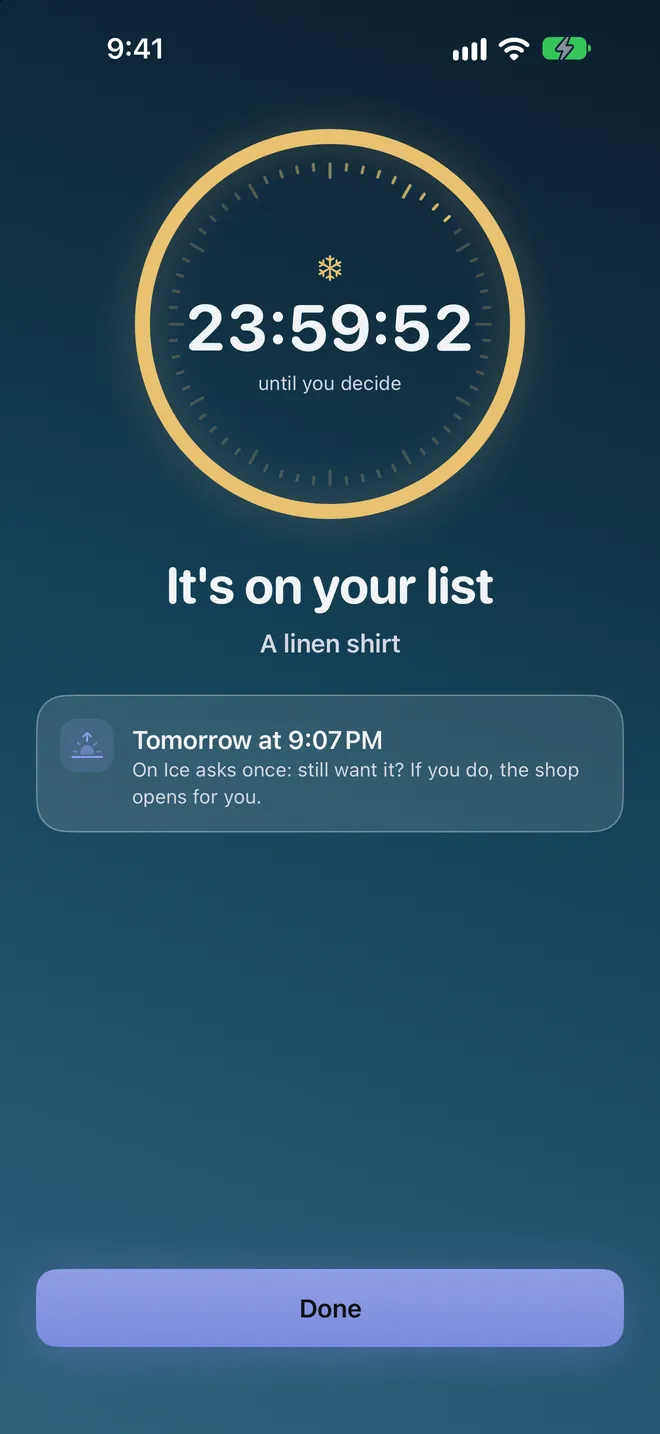
Tomorrow at the same time it asks the one question. If you let the thing go, the price you guessed is added to your estimated savings, which is the crossed off list from step 5, kept for you. With Premium the wait can be 12, 48 or 72 hours instead.
You can keep the rule perfectly well with a notes app. The app is for people who have tried that and found, as we did, that the hard part was never the waiting. It was remembering to start.